 how-to
Puppy Training Foundations in Libertyville IL: 2026 Guide
Table of Contents
- What to Prepare Before Your Puppy's First Training Session
- Your Step-by-Step Home Training Schedule for Puppy Training Foundations
- How to Stop Puppy Biting and Nipping Without Fear or Force
- Your Puppy Socialization Checklist for Libertyville and Lake County
- Puppy Obedience Training Timeline: Milestones by Age
- Common Puppy Behavioral Pitfalls in the First 6 Months
- When to Bring in a Professional Trainer for Puppy Training Foundations
- Frequently Asked Questions
Last Updated: October 1, 2026
What to Prepare Before Your Puppy's First Training Session
Puppy training foundations start before the first command is ever taught. The most important prep work is setting up a consistent environment, gathering the right tools, and deciding how you will communicate with your puppy. Owners who prepare properly often see faster progress in the first two weeks than those who jump straight into commands.
Here is what you need before session one:
- High-value treats cut into pea-sized pieces (soft treats work faster than crunchy ones)
- A 6-foot leash and a flat collar or harness that fits snugly without choking
- A quiet space with few distractions for the first few sessions
- A crate or pen for structured downtime between short training bursts
- A journal or notes app to track daily progress and setbacks
Your Step-by-Step Home Training Schedule for Puppy Training Foundations
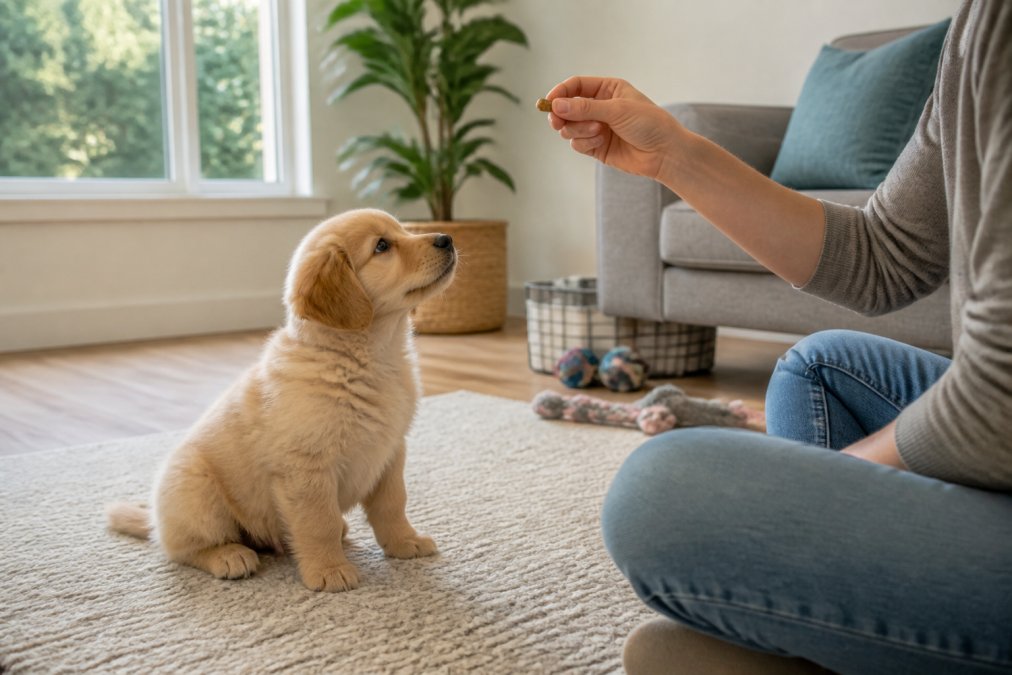
A structured home schedule turns scattered effort into steady progress. The key is consistency: same times, same cues, same rewards. Puppies learn through repetition and routine, not marathon sessions. Three to five short sessions per day, spaced a few hours apart, often outperform one long session.
The Daily Rhythm That Makes It Work
Build each day around four anchor points: morning potty and name game, midday obedience burst, afternoon socialization or handling practice, and evening review plus calm downtime. Keep every session under five minutes for puppies under 12 weeks and under ten minutes after 16 weeks. End each session while your puppy still wants more.
A simple daily template:
- 7:00 a.m., Potty outside, then 2 minutes of name recognition with high-value treats
- 10:00 a.m., 3 minutes of sit and come indoors, low distraction
- 1:00 p.m., 3 minutes of handling practice (paws, ears, collar) paired with treats
- 4:00 p.m., 5 minutes of leash introduction or socialization exposure
- 7:00 p.m., 3 minutes reviewing the day's cues, then structured chew time in the crate or pen
Week-by-Week Schedule from 8 to 16 Weeks
| Age | Focus | Daily Sessions | Key Goal |
|---|---|---|---|
| 8-10 weeks | Name recognition, potty routine | 4-5 short bursts | Puppy responds to name |
| 10-12 weeks | Sit, come, handling | 4-5 short bursts | Reliable sit indoors |
| 12-14 weeks | Leash intro, socialization | 3-4 short bursts | Calm leash acceptance |
| 14-16 weeks | Stay, leave it, public exposure | 3-4 short bursts | Focus around mild distractions |
How to Run a Single Session (60-Second Breakdown)
- 0-10 seconds: Get your puppy's attention with a treat at nose level, then lure into position.
- 10-20 seconds: Mark the correct behavior with a verbal marker like "yes" and reward immediately.
- 20-40 seconds: Repeat two to three reps of the same cue.
- 40-50 seconds: Add one small distraction (a step back, a toy on the floor).
- 50-60 seconds: End with a cue your puppy already knows well, reward, and release with a consistent word like "free."
What to Track Each Week
Keep a simple log with four columns: date, cue practiced, success rate (out of 10 reps), and notes on distractions. Owners who track progress catch plateaus early and adjust instead of repeating the same failed approach.
How to Stop Puppy Biting and Nipping Without Fear or Force
Puppy biting is normal, but it needs a clear, calm response. The goal is not to punish the behavior but to teach your puppy what to do instead. Fear-based corrections often backfire, creating anxiety or defensive reactions that make nipping worse.
Start with these steps:
- Yelp softly and withdraw for a few seconds when teeth touch skin
- Redirect to a toy the moment your puppy backs off
- End the play session if biting continues after two redirections
- Reward gentle mouthing with praise and a treat
- Stay consistent across every family member
Your Puppy Socialization Checklist for Libertyville and Lake County
Socialization is the process of exposing a puppy to new people, places, sounds, and animals in a calm, positive way during the critical window between roughly 3 and 16 weeks of age. Miss that window and fear-based behaviors become much harder to unwind later.
Use this checklist as your starting point:
- Meet 5-10 new people of different ages and appearances
- Walk on 3-4 different surfaces (grass, pavement, gravel, wood)
- Hear common sounds: vacuums, doorbells, traffic, thunder recordings
- Visit a calm outdoor setting with mild foot traffic
- Meet a friendly, vaccinated adult dog
- Ride in a car for short, positive trips
- Experience gentle handling of paws, ears, and mouth
Local Socialization Hotspots and Safe Exposure Ideas
Independence Grove Forest Preserve in Libertyville provides wide, quiet paths where a puppy can experience new sights without overwhelming crowds. The Libertyville Farmers Market on Thursday evenings offers mild foot traffic and friendly interactions if you keep visits short and stay on the perimeter.
Puppy Obedience Training Timeline: Milestones by Age
The puppy obedience training timeline varies by breed and individual temperament, but most puppies follow a predictable arc. Understanding that arc helps you set realistic expectations and avoid pushing too hard too soon.
| Age Range | Milestone | What Success Looks Like |
|---|---|---|
| 8-10 weeks | Name and eye contact | Puppy looks at you when called |
| 10-12 weeks | Sit and come | Responds indoors with no distractions |
| 12-16 weeks | Loose leash walking intro | Walks beside you for short stretches |
| 4-6 months | Stay, leave it, drop it | Holds position for 10-15 seconds |
| 6-12 months | Proofing around distractions | Responds in public settings |
The Three Phases Behind Every Milestone
Every command moves through three phases: acquisition, fluency, and proofing. In acquisition, you lure or shape the behavior and reward every correct rep. In fluency, you fade the lure, add a verbal cue, and reward most reps. In proofing, you add distance, duration, and distraction while rewarding intermittently. Skipping straight to proofing is the most common reason puppies "know" a command at home but ignore it outside.
How to Progress Without Stalling
- Add one variable at a time. If you increase distance, keep duration and distraction low.
- Use the 80% rule. Move to the next phase only when your puppy succeeds on roughly 8 out of 10 reps.
- Change locations before changing difficulty. A sit in the kitchen is not the same skill as a sit on a sidewalk.
- Keep sessions short. Three to five minutes per cue is enough for most puppies under 6 months.
- Retire the lure early. Treats should follow the behavior, not lead it, once the puppy understands the cue.
Proofing in the Real World
Proofing is where obedience becomes reliable. Start in your living room, then move to a driveway, then a quiet sidewalk, then a park at a distance from other dogs and people. Each new environment resets difficulty, so expect success rates to drop and reward more generously at first.
Common Puppy Behavioral Pitfalls in the First 6 Months
Most behavioral problems in the first six months trace back to a handful of predictable patterns. Recognizing them early saves months of frustration.
Common issues include:
- Jumping on people because greetings were rewarded with attention
- Demand barking reinforced by owners who give in
- Chewing on furniture when appropriate outlets are missing
- Leash pulling because the walk continues when the puppy pulls
- Separation distress from sudden alone-time increases without preparation
When to Bring in a Professional Trainer for Puppy Training Foundations
Professional help is worth it when progress stalls, when fear or aggression appears, or when you want a structured program that covers everything in the right order. Puppy training foundations are not just commands; they are the relationship patterns that shape how your dog responds to you for life.
Signs it is time to call a trainer:
- Nipping or biting that escalates past 16 weeks
- Fear responses to people, sounds, or handling
- Leash reactivity toward other dogs or strangers
- Resource guarding around food, toys, or resting spots
- A household where family members disagree on rules
Frequently Asked Questions
When should I start formal puppy training foundations?
Start the moment your puppy comes home, usually around 8 weeks. Short, positive sessions of 5 minutes, several times a day, build basic obedience and foundation skills before bad habits form. Formal group classes can begin once your vet confirms vaccinations are on track, often around 10 to 12 weeks. Early consistency matters more than long sessions.
What are the most effective ways to stop puppy biting and nipping?
Redirect nipping onto a toy the moment teeth touch skin, then pause play for a few seconds so the puppy learns that biting ends the fun. Keep sessions short, reward calm mouth behavior with treats, and never use physical punishment. Most puppies reduce biting significantly by 16 to 20 weeks as teething eases and impulse control improves.
How much does professional puppy training cost in the local area?
Pricing depends on the program format, session length, and whether you choose private lessons or group classes. Lake County Dogs lists current rates on its website and offers a free evaluation so you can see the plan before committing. Many local trainers also offer packages, so ask what is included before comparing quotes.
How long does it take to see results from puppy obedience training?
Owners often notice better focus and fewer nipping incidents within 2 to 4 weeks of consistent daily practice. Reliable commands like sit, come, and loose leash walking usually take 8 to 12 weeks. Behavioral issues such as fear or reactivity can take longer and often benefit from professional behavioral counseling alongside home practice.