 ultimate-guide
Professional Dog Obedience Training Cost: 2026 Guide
Table of Contents
- What Professional Dog Obedience Training Cost Includes
- Factors That Influence Dog Obedience Training Cost
- Group Classes vs. Private In-Home Dog Training Rates
- Board and Train Program Pricing Explained
- How Dog Obedience Training Duration Affects Cost
- DIY vs. Professional Training: A Cost-Benefit Analysis
- Hidden Fees and Regional Cost Variance
- Frequently Asked Questions
Last Updated: September 28, 2026
What Professional Dog Obedience Training Cost Includes
Professional dog obedience training cost is the total you pay a qualified trainer to teach foundational commands, manners, and reliable behavior in real-world settings. At Lake County Dogs, we've spent over 25 years in canine behavior modification.
Base Fees vs. Add-On Services
Base fees cover the core package: a set number of sessions, the trainer's time, and a defined curriculum. Add-ons are everything layered on top.
Common add-ons include:
- Extra sessions beyond the package
- In-home visits instead of a facility
- Specialized behavior modification for aggression or anxiety
- AKC Canine Good Citizen test preparation
- Multi-dog household adjustments
Factors That Influence Dog Obedience Training Cost
The biggest price driver is the complexity of your dog's behavior, not the number of commands you want taught.
Behavioral Assessment and Customized Training Plans
A behavioral assessment is the evaluation a trainer performs before writing your dog's plan, identifying triggers, temperament, and baseline obedience.
Certification Impact on Pricing
Certification affects price because it signals verified expertise: formal coursework and, often, practical evaluations.
Credentials that typically command higher rates include:
- Behavioral certification for aggression and anxiety cases
- AKC evaluator status for Canine Good Citizen testing
- Instructor credentials at recognized training institutions
You're paying for judgment, not just time.
Group Classes vs. Private In-Home Dog Training Rates
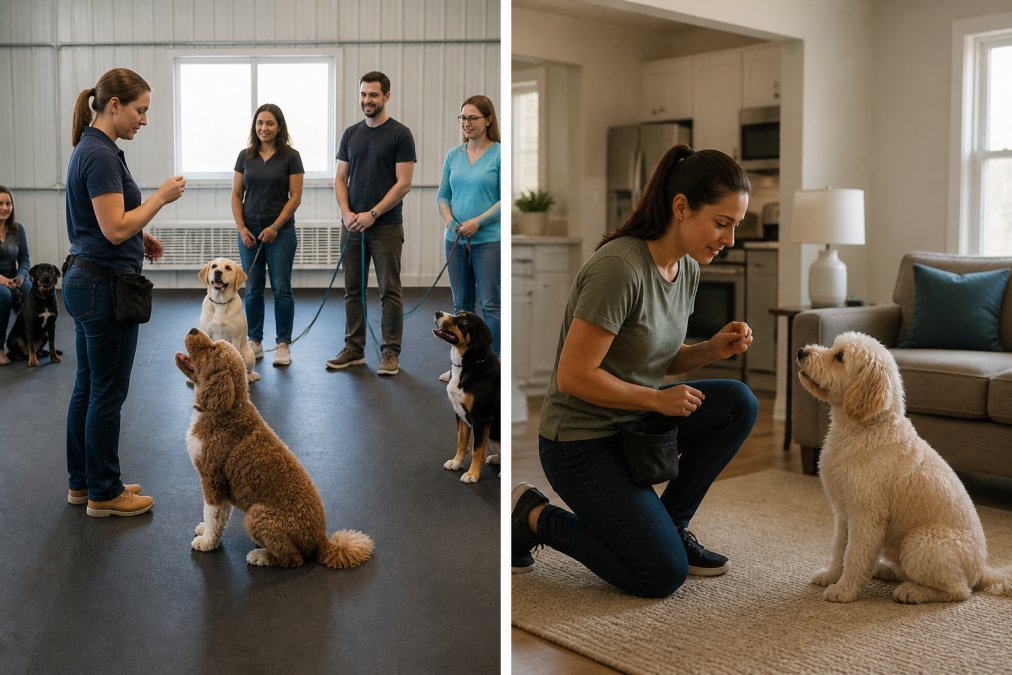
Group classes cost less per session than private in-home sessions but solve different problems: groups teach socialization and manners in a controlled setting, while private sessions target your dog's specific behavior at home.
| Format | Best For | Attention Level | Typical Cost Positioning |
|---|---|---|---|
| Group classes | Puppies, friendly adults | Shared among 4-8 dogs | Lowest per session |
| Private in-home | Reactivity, fear, aggression | One-on-one | Highest per session |
| Board and train | Intensive behavior cases | Full-time, off-site | Highest total package |
Board and Train Program Pricing Explained
Board and train program pricing reflects the most intensive option: your dog lives with the trainer for a set period with daily structured training. It costs more than weekly sessions because you're paying for around-the-clock care, housing, and multiple training blocks per day.
How Dog Obedience Training Duration Affects Cost
Dog obedience training duration is one of the clearest cost drivers: longer programs cost more, but not linearly. A six-week puppy course and a twelve-week behavior modification program differ in length and intensity.
DIY vs. Professional Training: A Cost-Benefit Analysis
Most pricing pages stop at the sticker price. The more useful question is what each path actually costs over the life of the dog, including the hidden costs owners rarely price in.
The four cost buckets to compare
Every training decision carries four costs, not one:
- Direct cash outlay, what you pay a trainer, buy in equipment, or spend on books and courses.
- Time cost, hours you personally spend training, researching, and correcting. Multiply your realistic weekly hours by the number of weeks you expect the process to take.
- Risk cost, the probability that the approach fails or makes the behavior worse, and what that failure costs to unwind (a second trainer, a veterinary behaviorist, a liability incident).
- Opportunity cost, the behaviors your dog doesn't learn while you're stuck troubleshooting, and the activities you miss because of them.
DIY looks cheapest in bucket one and most expensive in buckets two and three. Professional training inverts that. The right answer depends on which bucket your situation stresses most.
A simple break-even way to think about it
You don't need a spreadsheet, but you do need an honest estimate. Ask:
- How many hours per week can I realistically train, and for how many weeks?
- What is my time worth per hour to me (not to an employer, to you)?
- If my DIY attempt fails, what is my fallback and what does it cost?
- What is the cost of one incident, a bite, a lost dog, a destroyed item, a vet visit?
Where DIY genuinely wins
DIY is the right call when:
- Your dog is a puppy in the socialization window and you're teaching name recognition, sit, and potty routines.
- Your dog is food-motivated, confident, and has no bite history or reactivity.
- You can commit to short, daily sessions and you're willing to follow a structured curriculum rather than improvising.
- You pair DIY with a short group class for proofing around other dogs.
In those cases, a group class plus consistent home practice often matches private sessions at a fraction of the cost.
Where DIY quietly becomes the expensive option
DIY breaks down in predictable places:
- Reactivity and aggression. These require reading subtle body language and adjusting timing in real time. A mistimed correction or a flooded exposure can intensify the problem, and the fix costs more than the original training would have.
- Fear and shutdown. A fearful dog that is pushed too fast learns to distrust the training process itself, which lengthens every future program.
- Multi-dog households. Resource guarding and pack dynamics are hard to troubleshoot from a video.
- Rescue dogs with unknown history. You don't know the triggers until they appear, and by then you need a professional assessment.
The ROI framing that actually helps
Think of professional training as buying a shorter, more predictable timeline and lower risk of escalation. The return isn't just obedience.
A quick decision rule
- Confident puppy, basic cues, no red flags: DIY plus a group class.
- Friendly adult, leash manners, some proofing needed: group class, add private sessions only for specific gaps.
- Any fear, reactivity, aggression, or bite history: professional assessment first, then a customized plan.
- Owner schedule too inconsistent for weekly sessions: board and train, followed by a structured handoff.
The cheapest quote is rarely the cheapest outcome, but the most expensive quote isn't automatically the best one either. Match the format to the behavior, not to the price tag.
Hidden Fees and Regional Cost Variance
Two things blow up a training budget most: fees that weren't in the quote, and regional price gaps. Both are predictable once you know what drives them.
The hidden fees to ask about before you sign
A base quote usually covers instruction time and a defined curriculum. Everything below is commonly billed separately and just needs to be disclosed upfront:
- Behavioral assessment or evaluation fee. Sometimes bundled, sometimes a standalone charge. Ask whether it's credited toward the package if you enroll.
- Travel or in-home surcharge. Common when the trainer drives to you, especially outside a standard service radius. Ask what the radius is and what the per-mile or per-visit charge is beyond it.
- Equipment. Training collars, long lines, clickers, treat pouches, and platforms are sometimes included and sometimes billed at retail. Ask what's provided and what you're expected to bring.
- Certification or test fees. Canine Good Citizen testing and similar title evaluations often carry a separate fee paid to the governing organization, not the trainer.
- Follow-up or refresher sessions. Some programs include a set number; others bill each one. Ask what happens at the 30- and 90-day marks.
- Cancellation and rescheduling terms. Late-cancel windows and no-show fees vary widely. Get the policy in writing.
- Multi-dog adjustments. A second dog in the household often changes the plan and the price.
- Specialized behavior modification surcharge. Aggression, severe anxiety, and bite-history cases frequently carry a higher rate because they require more planning, more safety protocol, and more documentation.
How to read a quote like an editor
Separate any quote into three columns: included, optional, and billed separately. If a provider can't fill in all three, keep asking questions. A transparent quote names session count, assessment status, travel terms, and equipment list.
Why regional pricing varies so much
Training rates track the same forces as any local service business: overhead, demand, and travel time. The pattern is consistent enough to plan around.
- Dense metro cores. Highest rates. Rent, insurance, and staff costs are highest, and demand from a large owner base supports premium pricing. In-home visits carry the steepest travel surcharges because of traffic and parking.
- Suburban rings. Mid-range rates. Facility-based group classes are most competitive here because trainers can fill classes without long drives.
- Small towns and rural areas. Lowest headline rates, but the effective cost can rise once you factor in travel for in-home visits or the distance you drive to a facility. Fewer trainers also means less competition on price and longer waitlists.
- High cost-of-living regions generally. Rates run above the national middle because the trainer's own operating costs are higher. The reverse is true in lower cost-of-living regions.
A practical way to benchmark your local market
You don't need a published index to sanity-check a quote. Pull three to five local quotes and compare them on the same axes:
- Format (group, private in-home, board and train)
- Session count and session length
- Whether the assessment is included
- Travel terms
- Credentials and specialty
The variance question to ask every trainer
Ask directly: "What would change this price for my dog?" A good trainer names the variables, behavior complexity, travel distance, session count, and whether the case needs a behavior modification protocol. A vague answer means the price is set by feel, not scope, and is most likely to grow after you commit.
Putting it together
The cheapest market isn't always the cheapest outcome, and the priciest isn't always the best value. Compare quotes on scope, not headline price, and confirm every add-on in writing before you commit.
Frequently Asked Questions
What factors influence the cost of professional dog obedience training?
The main factors are the trainer's certification and experience, your dog's behavioral assessment, the training methodology used (such as positive reinforcement), session duration and frequency, and whether you choose group classes, private sessions, or a board and train program. Customized training plans for issues like aggression or anxiety typically cost more because they require more specialized expertise and time.
Is there a difference in cost between group classes and private in-home dog training rates?
Yes. Group obedience classes are generally the most affordable option because the trainer's time is split among several dogs. Private in-home dog training rates are higher per session because you get one-on-one attention in your own environment, which is often necessary for behavior modification, leash manners, or dogs that are reactive around other dogs.
How much should I budget for a board and train program?
Board and train program pricing depends on the length of stay, the intensity of the training curriculum, and the trainer's credentials. These programs cost more than weekly sessions because your dog receives daily training and care. Request a detailed quote that lists what is included, such as follow-up sessions, training equipment, and a service agreement.
Are there hidden costs associated with professional dog obedience training?
Some trainers charge separately for an initial consultation fee, training equipment (like e-collars or long lines), or follow-up sessions after the program ends. Always ask for a written service agreement that itemizes every charge. Reputable trainers will provide a clear breakdown before you commit, so you can compare the total investment rather than just the hourly rate.