 how-to
Stop Puppy Biting and Nipping: A Step-by-Step Guide
Table of Contents
- Why Puppies Bite and Nip: Understanding the Behavior
- Puppy Bite Inhibition Training: The First Step
- How to Redirect Puppy Biting to Appropriate Outlets
- Puppy Teething Timeline: What to Expect Month by Month
- Best Toys for Biting Puppies and How to Use Them
- Nighttime Biting and the Witching Hour: Managing Overstimulation
- Breed-Specific Biting Tendencies and Safety with Small Children
- When to Seek Professional Help for Puppy Biting
- Frequently Asked Questions
Last Updated: September 26, 2026
Why Puppies Bite and Nip: Understanding the Behavior
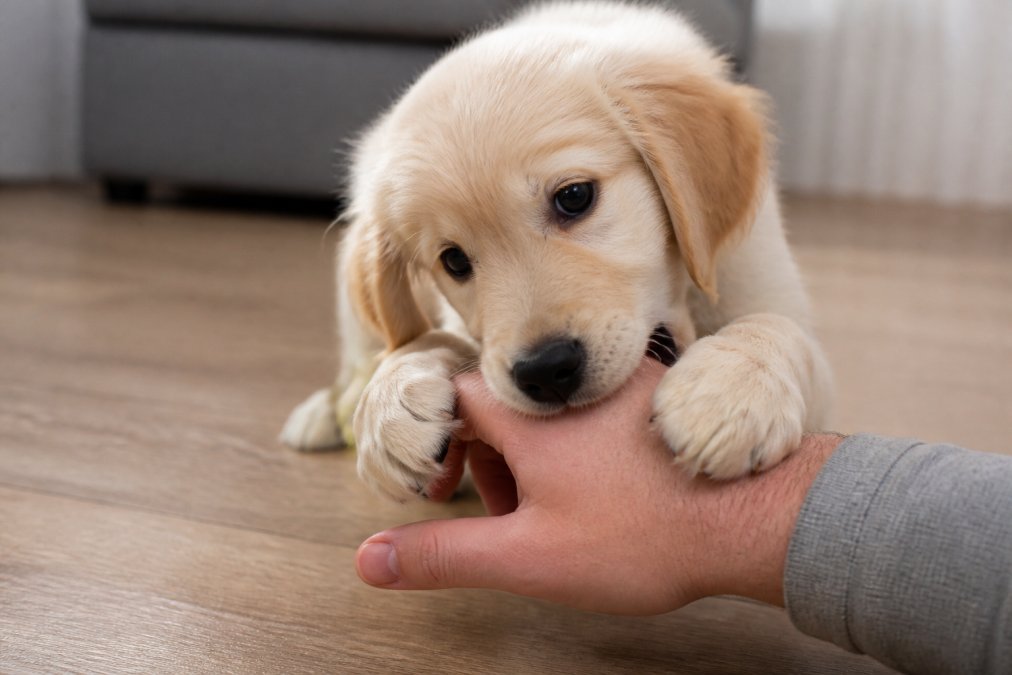
Puppy biting is a normal part of development, not a sign of aggression. Mouthing peaks between 8 and 16 weeks, when puppies explore the world teeth-first. The goal isn't to punish biting. It's to teach your puppy that human skin is off-limits.
Puppies bite for several reasons:
- Teething pain as new teeth push through
- Play and exploration
- Tiredness or overstimulation
- Hunger or the need to toilet
- Instinct carried from their litter
Normal Puppy Development vs. Red Flags
Mouthing is expected. Growling, snapping with a hard stare, or biting when cornered is different. Those cues can point to fear or pain. Talk to a vet or behavior specialist if you see them. The American Veterinary Medical Association's pet behavior resources explain the difference clearly.
Puppy Bite Inhibition Training: The First Step
Puppy bite inhibition training teaches your dog to control jaw pressure. It's the single most useful skill you can build in the first few months.
Here's how it works:
- Let your puppy mouth gently during play.
- The moment a bite hurts, yelp high and pull your hand away.
- Pause play for 10 to 20 seconds.
- Resume. Repeat every time the pressure increases.
- After a week or two, react to softer bites too.
How to Redirect Puppy Biting to Appropriate Outlets
Redirecting puppy biting means swapping your hand for something your puppy can chew. This is how you teach the behavior you want instead of just stopping the behavior you don't.
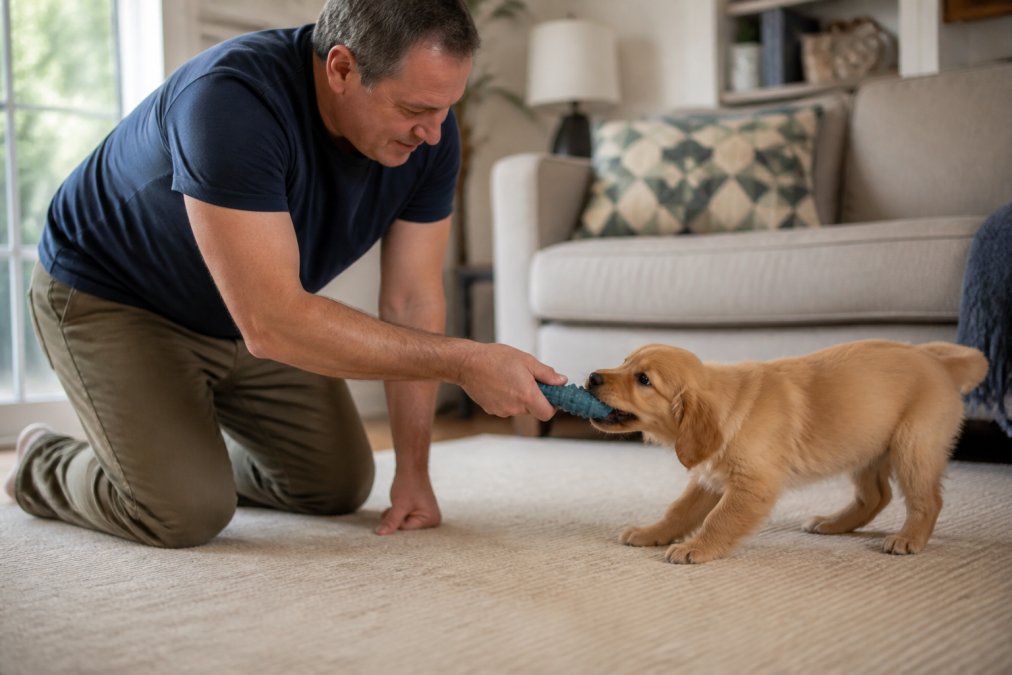
Try this routine:
- Keep a chew toy in every room
- When teeth touch skin, say "toy" and offer the chew
- Praise the moment your puppy takes it
- Repeat during every play session
Puppy Teething Timeline: What to Expect Month by Month
The puppy teething timeline runs from about 3 weeks to 7 months. Knowing what's coming helps you plan.
| Age | Dental Stage | What to Expect |
|---|---|---|
| 3-4 weeks | Baby teeth appear | Early mouthing with littermates |
| 8-12 weeks | All 28 baby teeth in | Peak nipping, heavy chewing |
| 12-16 weeks | Baby teeth start falling out | Extra mouthiness, gum soreness |
| 4-6 months | Adult teeth push through | Strong urge to chew everything |
| 6-7 months | All 42 adult teeth in | Biting usually fades |
Best Toys for Biting Puppies and How to Use Them
The best toys for biting puppies match their size and chewing style. A toy that's too hard can damage teeth. One that's too soft gets destroyed in minutes.
Good options include:
- Rubber chew toys for heavy chewers
- Rope toys for tug and gentle mouthing
- Treat-stuffable toys for mental work
- Soft plush toys for comfort, not chewing
- Chilled teething toys for sore gums
Nighttime Biting and the Witching Hour: Managing Overstimulation
Many owners sail through the day and then get ambushed between 7 and 9 p.m. by a puppy who seems to have forgotten every rule. This is the witching hour, and it is one of the most common reasons people search for help with puppy biting. It is not aggression and it is not a training failure. It is a nervous system problem.
What Is Actually Happening
By evening, a puppy has accumulated a full day of sensory input, sounds, smells, handling, new surfaces, brief training reps. Puppies have immature self-regulation. When arousal crosses a threshold, the part of the brain that controls jaw pressure goes offline before the part that controls movement does. That is why a puppy can look frantic and still be completely unresponsive to a known cue like "sit."
- Overstimulated: still has gas in the tank, just no brakes. Zoomies, shark-mode biting, jumping, grabbing pant legs. Needs a decompression outlet.
- Overtired: running on empty. Glassy eyes, heavy panting, sudden loss of bite control, biting that gets harder instead of softer. Needs sleep, not play.
A Practical Evening Protocol
- Anchor the last nap. Aim for a nap ending no later than about 6 p.m. so your puppy is not entering the evening already depleted.
- Front-load enrichment. Do the sniff walk, puzzle feeder, or training session in the late afternoon, not at 8 p.m. Mental work is more tiring than physical work for most puppies.
- Dim the environment after dinner. Lower lights, turn off the TV, reduce foot traffic through the room. Arousal is contagious.
- Switch to calm chewing. A stuffed, frozen toy gives the mouth a job without spiking arousal. This is the single most reliable tool for the 7 to 9 p.m. window.
- Enforce a nap if the biting escalates. If biting gets harder, not softer, the answer is the crate or pen, not more play.
- Keep bedtime boring and identical. Same order, same room, same cue word. Predictability lowers arousal.
What Not to Do
- Do not add a second walk at 8 p.m. hoping to "wear them out." For an overtired puppy, this backfires.
- Do not yell or grab. High-arousal corrections raise arousal further.
- Do not skip the nap because your puppy "doesn't seem tired." Overtired puppies rarely look sleepy, they look wild.
When the Witching Hour Is Something Else
If evening biting comes with growling, a hard stare, snapping when you reach toward the puppy, or biting that is clearly directed at a specific person, that is not a witching-hour pattern. Those cues can point to fear or pain, and they warrant a conversation with your veterinarian or a certified behavior specialist rather than a nap-and-chew protocol.
Breed-Specific Biting Tendencies and Safety with Small Children
Generic advice treats every puppy the same. In practice, the biting you are trying to stop is shaped by what the dog was originally bred to do, and that changes both the intensity and the trigger.
How Breed Groups Differ
- Herding breeds (border collies, Australian shepherds, heelers, corgis): bred to move livestock by nipping at heels and staring down animals. They often target moving feet, ankles, and pant legs, and they may add a hard eye and a crouch. The trigger is motion, not your hand.
- Terriers (Jack Russells, rat terriers, Scotties): bred to pursue and grab small fast-moving prey. Expect quick, grabby, high-intensity nips and a strong chase drive toward anything that darts.
- Sporting and retrieving breeds (labs, goldens, spaniels): bred to carry things in their mouths softly. They often mouth constantly but with low pressure, the problem is frequency, not force.
- Toy and companion breeds (pugs, Cavaliers, Maltese): generally lower prey drive and softer mouths, but they are also more likely to be over-handled, which can produce defensive nipping when picked up or restrained.
- Working and guardian lines: within the same breed, working lines typically bite harder, longer, and with a lower arousal threshold than show lines. A working-line puppy is not a harder version of the same dog, it is a different operating system.
This matters because the fix changes. A herding puppy needs a substitute outlet for motion-triggered nipping (a flirt pole, a herding ball, tug with rules). A terrier needs a managed environment where small fast things are not available to chase. A retriever needs a chew toy in the mouth almost constantly. A toy breed needs less handling, not more correction.
Safety Protocols for Homes with Toddlers and Young Children
Most biting guides are written for the adult owner. Households with a child under about five need a different set of rules, because a toddler cannot reliably read a puppy's warning signals and cannot reliably follow instructions under stress.
Non-negotiables:
- Never leave a puppy and a young child alone together, not for a minute, not in another room, not "just to grab something." This is the single rule that prevents the majority of bites to children.
- Separate by default, together by design. Use baby gates, pens, and crates so the puppy has a space the child cannot enter, and the child has a space the puppy cannot enter. Coexistence should be supervised and short, not constant.
- Teach the child one move, not five. "Stand still like a tree and look away" is the only instruction a toddler can execute mid-bite. Running and screaming escalate the chase.
- Keep all interaction on the floor. No puppy on the couch, bed, or lap with a small child. Height and restraint both raise bite risk.
- No face-to-face contact. No kissing the puppy, no holding it at face level, no letting the child put hands near the food bowl or chew toy.
- Supervise toy play with a barrier. Tug and fetch are fine when an adult is holding the leash or standing between the child and the puppy.
Age and Impulse Control
A puppy under six months does not have full impulse control, the frontal circuitry that suppresses a bite is still developing. Expecting a four-year-old to manage a four-month-old puppy is not a fair ask of either of them. The adult in the room is the safety system.
When Breed and Child Risk Overlap
If you have a high-drive herding or terrier puppy and a child under five, get ahead of it. Enroll in a puppy class that includes child-handling practice, and consider a one-on-one session with a certified behavior specialist before the biting becomes a pattern. Early structure is far easier than repair.
When to Seek Professional Help for Puppy Biting
Most puppy biting fades by 7 months with consistent training. Get help sooner if you see:
- Hard bites that break skin after 5 months
- Growling, snarling, or snapping when approached
- Biting that gets worse, not better, with training
- Fear or flinching when you reach for your puppy
- Biting directed at children
Frequently Asked Questions
What age do puppies stop nipping and biting?
Most puppies show a significant drop in biting between 4 and 6 months as their adult teeth come in and bite inhibition training takes hold. The puppy teething timeline runs from about 3 weeks to 6 months, with the most intense mouthing between 8 and 16 weeks. Full stop usually happens by 7 to 9 months with consistent training and redirection.
Is puppy biting a sign of aggression?
In most cases, no. Puppy biting is normal play behavior and exploration, not aggression. Aggression red flags include stiff body language, growling while guarding food or toys, snapping with a hard stare, or biting that escalates rather than softens. If your puppy shows these signs, especially past 16 weeks, a professional evaluation is the right next step.
Should I tap my puppy on the nose when he bites?
No. Tapping or physical punishment teaches a puppy to fear hands and can increase biting through defensive responses. It also damages the trust you need for bite inhibition training. Instead, use a high-pitched yelp to mimic a littermate's pain signal, pause the interaction for 10 to 20 seconds, then redirect to a chew toy. Consistency matters more than correction.
How do I redirect my puppy when they bite my hands?
Keep a chew toy within arm's reach at all times. The moment teeth touch skin, say 'ouch' in a sharp, high-pitched tone, withdraw your hand, and immediately offer the toy. Praise when your puppy takes it. Repeat every time. This redirection method works because it gives your puppy a legal outlet for the same urge, and it teaches that hands end play while toys continue it.
Puppy biting can feel endless, but it's a phase you can shape with the right approach. At Lake County Dogs, our trainers build customized plans around your puppy's breed, temperament, and home life. With over 25 years of experience and AKC-approved evaluation, we help families turn mouthy puppies into well-mannered companions. Book a free evaluation with Lake County Dogs and get a plan that fits your dog.