 how-to
7 Tips for Reactive Dog Walking That Actually Work
Table of Contents
- Why Leash Reactivity Happens (and What It Means for Walks)
- Reactive Dog Walking Equipment: Build a Safe, Secure Setup
- Reactive Dog Threshold Distance: How Close Is Too Close?
- How to Calm a Reactive Dog on Walks: Engagement Before Escalation
- Emergency U-Turn Dog Training: A Step-by-Step Encounter Protocol
- Route Planning: Quieter Paths, Off-Peak Hours, and Visual Barriers
- What to Do After a Reaction (and When to Call a Professional)
- Conclusion
- Frequently Asked Questions
Last Updated: October 21, 2026
Why Leash Reactivity Happens (and What It Means for Walks)
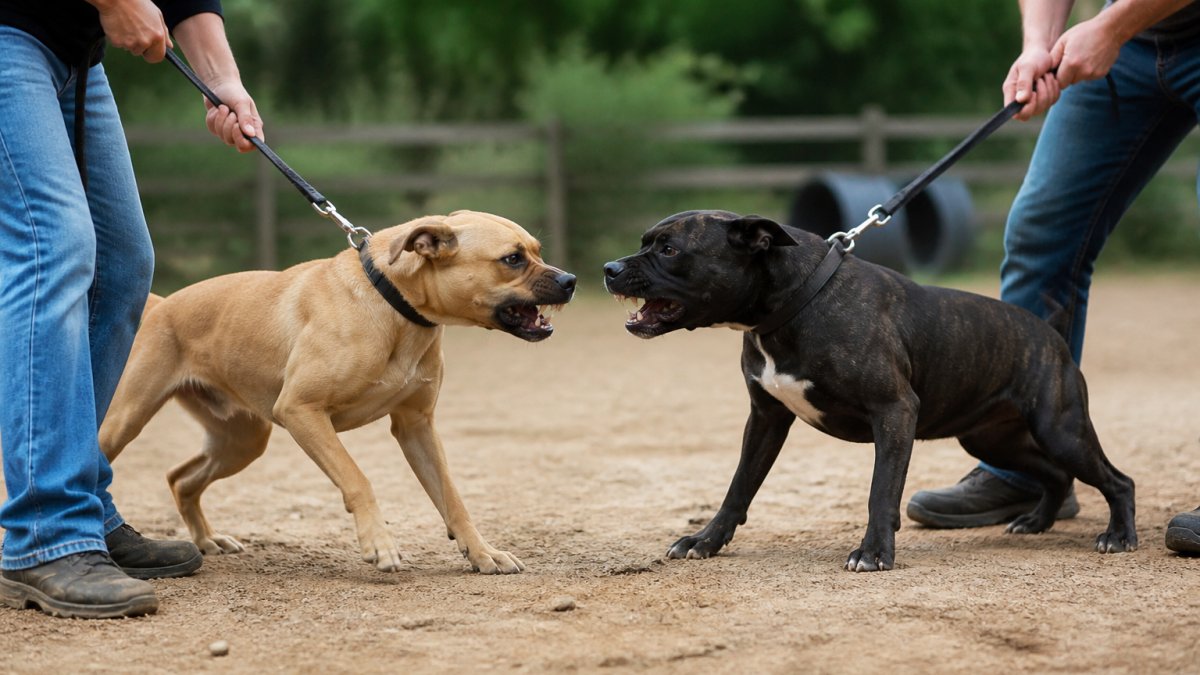
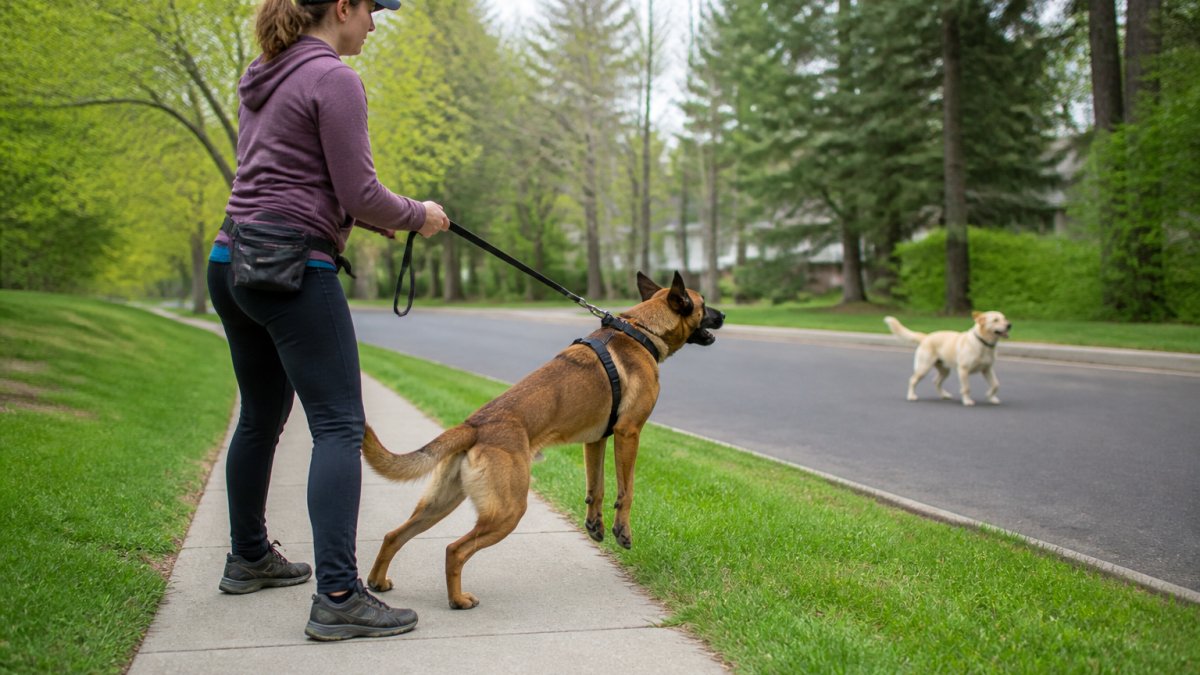
A reactive dog isn't disobedient. The leash removes the escape route a dog would normally use, so flight becomes fight.
At Lake County Dogs, we've worked with reactive dogs for over 25 years. The dog wants distance. The leash says no.
Common triggers include:
- Other dogs, especially oncoming ones
- Strangers, joggers, and cyclists
- Cars, skateboards, and delivery trucks
Training that ignores the cause won't hold. Read the dog first, then build the walk around what you find.
Reading Your Dog's Stress Signals Early
Dogs broadcast stress long before they bark. Catching those signals is the most useful skill in reactive dog walking.
Watch for these early signs:
- Stiff body and a raised, frozen tail
- Hard staring at a trigger
- Lip licking, yawning, or sudden sniffing
A common mistake is waiting for the bark. By then, the dog is already over threshold and can't learn. Act at the first signal.
Reactive Dog Walking Equipment: Build a Safe, Secure Setup
The right reactive dog walking equipment keeps the dog secure and gives you control without adding pain. Skip aversive gear and treat this as a safety system, not a shopping list.
The four layers of a secure setup
- A well-fitted harness with a front clip. The front clip gives you steering leverage, not force. It turns the dog's forward pull into a sideways redirect instead of a tug-of-war.
- A fixed-length leash, 4 to 6 feet. Never a retractable one. A fixed leash lets you keep a consistent, loose loop and gives you something to gather quickly if you need to shorten up.
- A backup attachment. Connect the leash to the harness and run a second clip (or a short coupler) from the harness to the collar. If one piece of hardware fails during a lunge, the dog is still attached. This is cheap insurance and the single most overlooked piece of reactive-dog gear.
- High-value treats in an easy-reach pouch. If you have to dig for food, you've already lost the moment.
Management tools vs. training tools
A management tool prevents a bad outcome today; a training tool changes the dog's emotional response over time. A front-clip harness, backup clip, and muzzle are management, they keep everyone safe while you do the actual behavior work: engagement, threshold distance, and counter-conditioning.
Owners often buy gear hoping it will fix the reactivity. It won't. Gear buys safety and control so training has room to work, worth every dollar, but don't confuse the two.
Muzzle fit and use
A muzzle is not a punishment or an admission of failure. For dogs with a bite history, strong prey drive, or unpredictable reactions around strangers, a well-fitted basket muzzle is one of the most responsible pieces of equipment you can own, it lets you walk, train at a safe distance, and protect the public.
Fit rules that matter:
- Basket style, not a soft fabric sleeve. The dog needs to pant, drink, and take treats. A basket muzzle allows all three.
- Room to pant fully. The dog's mouth should open wide inside the muzzle. If the dog can't pant, the muzzle is too small and becomes a welfare problem on warm walks.
- No rubbing at the nose bridge or behind the ears. Check after every walk for redness or hair loss.
Introduce the muzzle slowly with treats, the same way you'd condition any new gear. A dog that panics can slip it, so most practitioners recommend several short, positive sessions before the first real walk.
Do a five-second gear check before every walk: harness straps snug, backup clip attached, leash clip closed, treat pouch stocked. Most equipment failures happen at the clip, not the harness.
Fit checks that prevent failures
Check for rubbing under the arms and room for two fingers under each strap. A loose harness can slip; a tight one restricts movement and creates sores. Re-check fit monthly on a growing dog and after any weight change.
Reactive Dog Threshold Distance: How Close Is Too Close?
Reactive dog threshold distance is the closest your dog can be to a trigger and still think clearly. Cross it and training stops working. Threshold isn't a fixed number, it moves with the dog, the day, and the trigger.
How to measure threshold distance
You can't eyeball this reliably. Use a simple, repeatable method:
- Pick a known trigger, a quiet street corner where dogs pass, or a park path with predictable foot traffic.
- Start far away, farther than you think you need. Fifty feet is a reasonable starting point for many dogs; some need a hundred or more.
- Walk a parallel line, not toward the trigger. Moving parallel keeps the distance stable while you watch the dog.
- Watch for the first stress signal, ears pinning, body stiffening, hard stare, leash tension without a pull.
- Mark the distance where the first signal appears. That's your working distance. Back up a few feet and train there.
Repeat on several walks. You'll see a range rather than a single number, plan around that range.
The three-zone decision guide
- Under threshold (green zone): The dog takes treats, responds to their name, and can turn away from the trigger. This is where learning happens. Train here.
- At threshold (yellow zone): The dog stares, freezes, or takes treats slowly but still checks in with you. Hold this distance, don't push closer, and keep the session short.
- Over threshold (red zone): The dog barks, lunges, won't take food, or can't hear you. Learning has stopped. Retreat immediately and calmly.
The goal is not to sneak closer over time, but to expand the green zone by training at its edge, so the dog can eventually tolerate less distance without crossing into yellow.
Why threshold changes day to day
A tired dog tolerates less. Wind carries more scent and raises arousal. A dog that just had a hard encounter is already primed. Hormones, weather, time of day, and recent exercise all shift the line, which is why a distance that worked yesterday can fail today, and why you recheck threshold at the start of every walk.
Keep a simple threshold log: date, trigger type, approximate distance, and whether the dog stayed green, hit yellow, or went red. After a few weeks, patterns emerge, which triggers are hardest, which times of day are safest, and whether the working distance is genuinely shrinking.
What to do when you cross it
Crossing threshold isn't a training failure; it's data. The response matters more than the event:
- Increase distance immediately. Turn and walk away at a calm, brisk pace. Don't run, and don't scold.
- Reduce demands. Stop asking for cues the dog can't hear right now. No sits, no name calls, no leash pressure.
- Let the dog decompress. Sniffing, shaking off, and a quiet spot to settle are all recovery behaviors. Give them time.
When to increase distance vs. when to end the walk
A useful rule: if the dog recovers within a few minutes and takes treats again, continue at a greater distance. If the dog stays wired, scanning, unable to settle, refusing food, the walk is over for training purposes. Pushing through a red-zone walk teaches the dog that walks are stressful.
Threshold distance is a moving target, not a fixed number. Measure it, log it, and treat every crossing as information about where to train next, not as a setback.
How to Calm a Reactive Dog on Walks: Engagement Before Escalation
The fastest way to calm a reactive dog on walks is to build engagement before the trigger appears.
Start in a low-distraction space, like your driveway. Say the dog's name, mark and reward the moment they look at you.
Next, practice loose-leash walking with frequent check-ins. Reward the dog for choosing you over the environment.
Food rewards do the heavy lifting.
Engagement is not a trick you pull out during an emergency. It's a habit you build on every quiet walk so it's automatic when things get hard.
Emergency U-Turn Dog Training: A Step-by-Step Encounter Protocol
Emergency U-turn dog training is a rehearsed exit: you turn and move away from a trigger before your dog reacts, giving the dog distance instead of a confrontation.
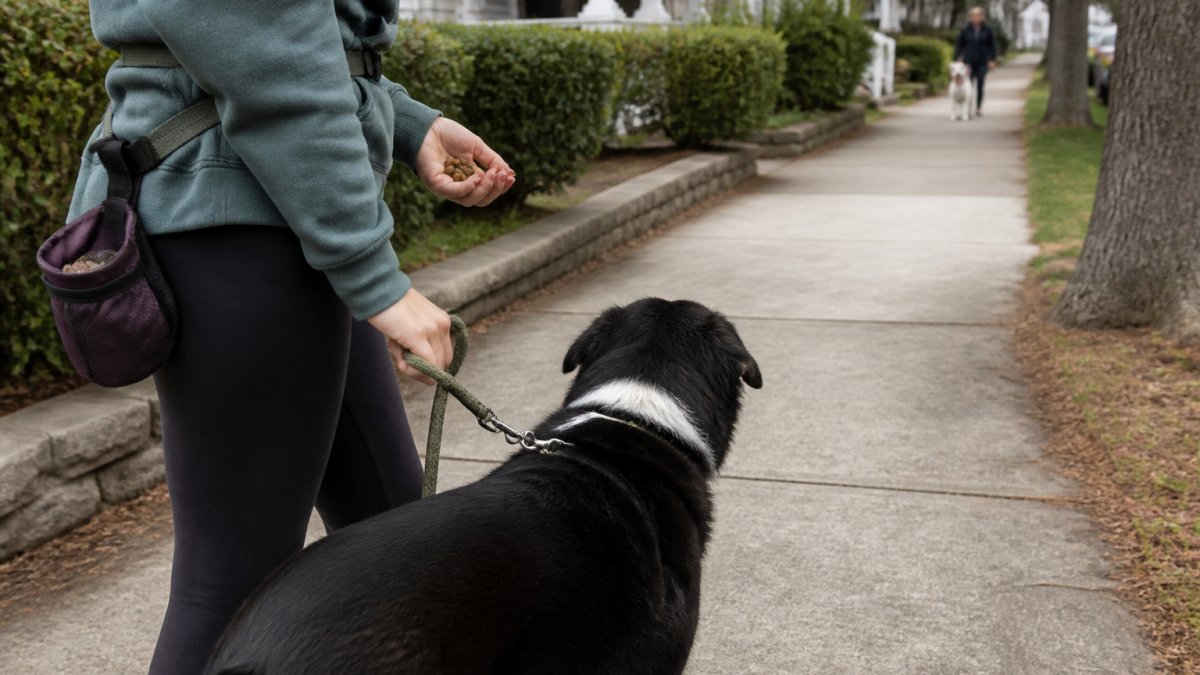
Practice the protocol when no trigger is present, then use it live:
- Spot the trigger early and note the distance.
- Cue your dog's name and reward the head turn.
- Turn your body and walk away at a brisk, calm pace.
- Reward the dog for moving with you, not for looking back.
- Put a visual barrier, like a parked car, between you and the trigger.
- Once calm, resume the walk on a quieter route.
Keep your body relaxed, a tight leash and tense handler signal danger. Breathe, move smoothly, and let the treats do the talking.
Route Planning: Quieter Paths, Off-Peak Hours, and Visual Barriers
Route planning is the quietest win in reactive dog walking. You can't control every trigger, but you can control where and when you walk.
Plan around these:
- Off-peak hours: early mornings and late evenings mean fewer dogs and people.
- Quiet routes: side streets and wide open paths beat crowded parks.
- Visual barriers: hedges, parked cars, and fences block line of sight and lower arousal.
Scout new routes without your dog first. Note where dogs live, where kids play, and where blind corners hide surprises. A five-minute scouting walk saves a hundred stressful ones.
What to Do After a Reaction (and When to Call a Professional)
A reaction isn't a failure. It's information. What you do in the next few minutes decides whether the dog recovers or stays wired.
After a reaction:
- Move away from the trigger immediately and calmly.
- Don't scold. Correction adds fear and confirms the trigger was dangerous.
- Let the dog shake off, sniff, or decompress in a quiet spot.
Expect recovery to take time. A hard reaction can leave a dog on edge for hours, so give a real rest period rather than pushing through.
When should you call a professional? At Lake County Dogs, our free evaluation covers exactly that: what's driving the behavior and what a realistic plan looks like.
Conclusion
Reactive dog walking is a skill you build, not a problem you eliminate overnight.
If your dog's reactions feel unmanageable, you don't have to figure it out alone. Lake County Dogs offers customized, science-based behavior programs led by Gary Boots, an AKC-approved evaluator with over 25 years of experience.
Book a free evaluation with Lake County Dogs and take the first calm walk toward a more confident dog.
Frequently Asked Questions
How far away should I stay from a trigger when walking my reactive dog?
Start farther than you think you need. Watch your dog: if they can take treats, respond to their name, and keep a loose leash, you are outside their threshold. If they stiffen, stare, or stop eating, you are too close. Move back until calm behavior returns, then note that distance. For many reactive dogs it starts at 30 to 50 feet and shrinks gradually over weeks of consistent training sessions. Reactive dog threshold distance is individual, so measure it for your dog rather than guessing.
What should I do if my dog reacts during a walk?
Increase distance immediately and calmly. Turn and move away without jerking the leash or scolding, since added tension confirms the trigger is scary. Once your dog can respond again, ask for a simple behavior like a sit or name response, reward it, and give them recovery time before continuing. End the walk on an easy note if needed. One reaction does not erase progress, but repeated rehearsals of the same reaction will, so plan the next route to stay under threshold.
Should I walk a reactive dog every day?
Yes, daily walks matter, but quality beats distance. A short, calm walk under threshold does more for reactive behavior than a long, stressful one. If your dog had a rough outing, swap the next day for a quieter route at an off-peak hour, or substitute a sniff walk in a low-traffic area. Consistent, low-stress exposure builds calm behavior faster than pushing through triggers every day.
Why is my dog only reactive when on a leash?
A leash removes your dog's ability to flee or choose distance, so normal stress responses like barking and lunging look exaggerated. Many dogs who are fine off-leash in a yard react on leash because they feel trapped. That is why reactive dog walking equipment, threshold distance, and calm handler demeanor matter so much: they give the dog back a sense of control. A qualified behavior professional can assess whether fear, frustration, or past experience is driving it.