 how-to
Training Two Dogs That Fight: A Step-by-Step Plan
Table of Contents
- Why Dogs in the Same Household Fight
- Play Fighting vs. Serious Fighting: How to Tell the Difference
- Signs of Resource Guarding in Dogs That Spark Conflict
- How to Safely Break Up a Dog Fight
- A Step-by-Step Household Training Plan for Dogs That Fight
- Finding the Best Dog Training for Aggression When You Need Help
- Measuring Progress and Deciding When to Advance
- Conclusion: A Path to Peace for Two Dogs That Fight
- Frequently Asked Questions
Last Updated: October 5, 2026
Why Dogs in the Same Household Fight
Two dogs that fight in the same home is one of the hardest behavior problems to live with. At Lake County Dogs, we see it constantly: the dogs are fine apart, but the moment they share a hallway, a couch, or your attention, tension snaps.
Dogs that fight under the same roof are often in an unstable relationship, not a "dominance battle." What matters is which dog controls access to what: food, toys, your lap, the doorway, the bed.
Common flashpoints we see in multi-dog homes:
- Food bowls and chews
- High-value toys and bones
- Doorways, stairs, and tight hallways
This is workable, but it does not fix itself, ignoring it makes the next fight worse.
Play Fighting vs. Serious Fighting: How to Tell the Difference
Play fighting is loose, bouncy, and take-turns. Serious fighting is stiff, fast, and one-sided. Reading dog body language is the single most useful skill you can build.
Play fighting looks like this:
- Both dogs take turns being "on top"
- Bodies are relaxed and wiggly
- Play bows (front down, rear up) appear often
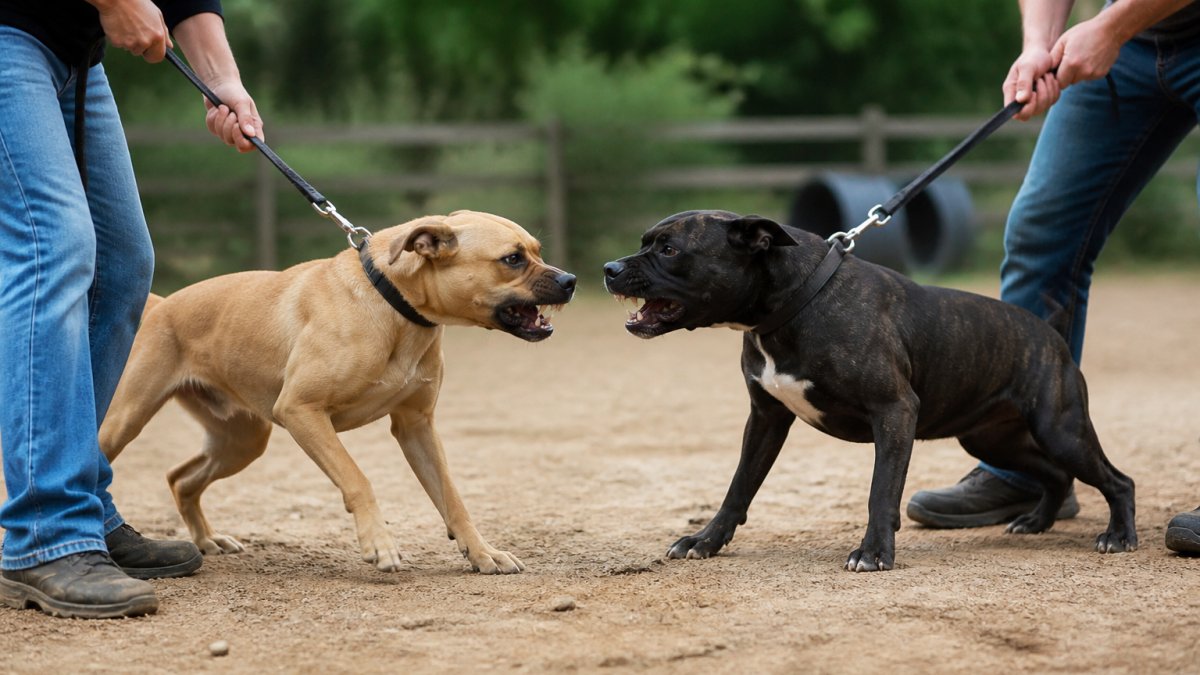
Serious fighting looks like this:
- Stiff, tense bodies and hard stares
- One dog keeps trying to get away
- Lips pulled back, hackles up, growling that does not stop
If unsure, treat it as serious. Separate them briefly: if both come back loose and want to play, it was likely play; if one avoids the other or freezes, that is a warning sign.
Signs of Resource Guarding in Dogs That Spark Conflict
Resource guarding is when a dog defends something it values. It is one of the most common causes of fights between household dogs.
Watch for these early warning signs:
- Freezing over a bowl, bone, or toy
- A hard stare at the other dog
- Lip licking, whale eye (whites showing), or turning the head away
The most common guarded resources in a two-dog home are food, chews, toys, your attention, and personal space.
A simple tracking method we use:
| Trigger | Which Dog Guards | Warning Sign | Fix |
|---|---|---|---|
| Food bowl | Older dog | Stiff body, stare | Feed in separate rooms |
| Chew bones | Younger dog | Growl, lip curl | Chews only in crates |
| Couch spot | Either dog | Body block | Block couch access |
| Your attention | New dog | Pushing, snapping | One-on-one time daily |
Once you know the triggers, you stop rehearsing the fight. Every fight a dog practices makes the next one more likely.
How to Safely Break Up a Dog Fight
Safety first. Never reach your bare hands into a dog fight, most serious human bite injuries in multi-dog homes happen when an owner grabs a collar or reaches between heads. This protocol keeps your hands away from teeth and breaks the fight without adding arousal.
Before a fight: set up your environment
Keep these items in one accessible "fight kit" so you have seconds, not minutes, to act:
- An air horn or a loud shake can
- Two slip leads (not clip leashes, they are faster to loop)
- A sturdy barrier: a baby gate, a large board, or a couch cushion
During a fight: the separation protocol
- Stay calm and do not scream. Yelling raises arousal and can pull other dogs in. Use a low, firm voice only to cue a dog that still responds.
- Do not grab collars or scruff. This is the most common way owners get bitten, the head is where the teeth are.
- Use a barrier first. Wedge a board, gate, or cushion between the dogs to create a physical break without putting your hands in the fight.
- If you must go hands-on, use the wheelbarrow method. Two people, one per dog: grab the rear legs at the top of the thigh, not the tail, not the collar, and lift and pull backward. This breaks the grip and moves the dog away from the other dog's head. Alone, loop a slip lead around one dog's rear legs and pull backward while using a barrier on the other.
- Never pull dogs apart by the collar in opposite directions. This can cause neck and spinal injuries and often makes the grip tighter.
- Separate immediately and completely. Different rooms, doors closed, no visual access. Do not try to "let them sort it out."
- Do not punish after the fight. Punishment teaches nothing useful, can make them more defensive at the next trigger, and damages your relationship with both dogs.
If you cannot safely separate them, make a loud noise, an air horn, a pot, a shake can, to startle them apart, then separate immediately. Noise buys you a second, not a solution.
After a fight: medical and behavioral assessment
This is the step most owners skip, and where the real risk lives.
Medical check:
- Even small punctures need a veterinarian. Dog bites carry infection, and puncture wounds can seal over and abscess within 24-48 hours.
- Check for hidden injuries: armpits, groin, neck, and inside the ears are common bite targets.
- Watch for lethargy, swelling, or reluctance to move in the days after. These can signal infection or internal injury.
Behavioral assessment:
- Note what happened right before the fight: what resource, what space, what trigger. This is your data for the training plan.
- Watch for behavior changes in the days after. A dog that was social and is now hiding, freezing, or avoiding the other dog is telling you the relationship has shifted.
- If a dog stops eating, stops sleeping normally, or shows new fear around the other dog, involve a qualified behavior professional rather than pushing forward with training.
When to call for help immediately
Call a veterinarian or a qualified behavior professional the same day if:
- A fight drew blood or required a vet visit
- One dog is hiding, shaking, or refusing to eat after the fight
- You feel unsafe breaking up fights in your home
A safety-led response, barrier first, hands away from teeth, medical check after, behavior log always, separates a manageable multi-dog home from a dangerous one.
A Step-by-Step Household Training Plan for Dogs That Fight
This is the plan we build with families. It runs over weeks, not days. The goal is calm behavior around each other, not forced friendship.
Total time: 4-8 weeks of daily practice Difficulty: Moderate, needs consistency
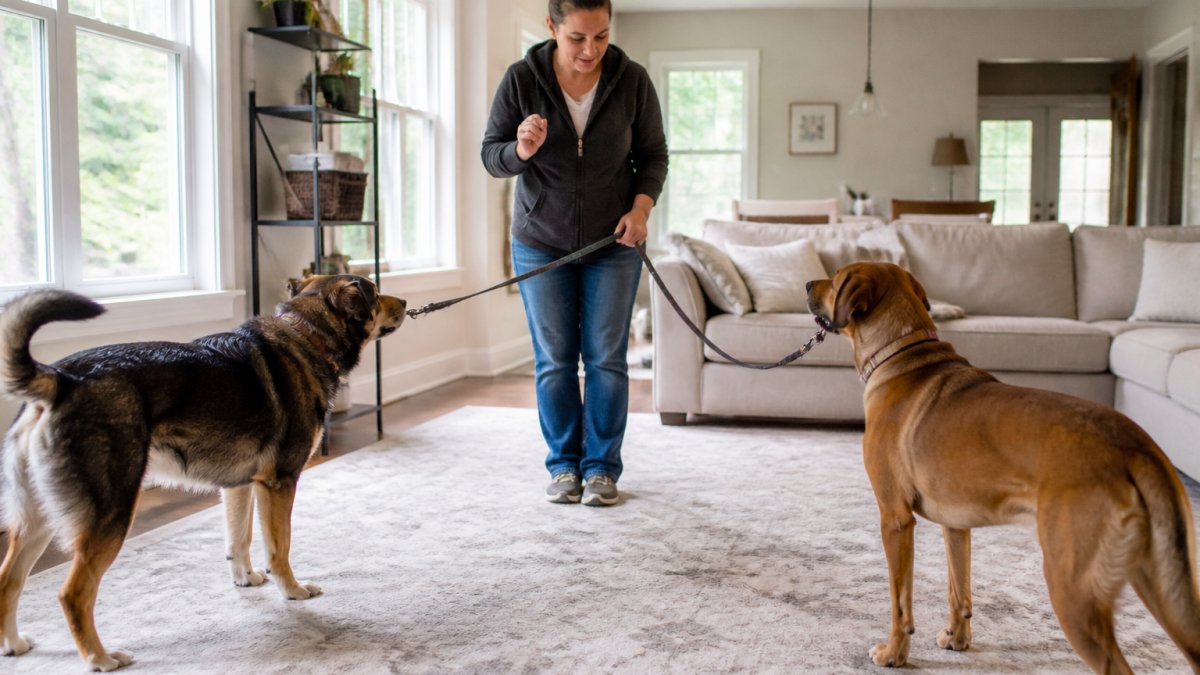
Step 1: Separate and Stabilize
Start with full separation. Each dog gets its own space, food bowl, and rest area. This is not punishment, it is a reset.
- Use crates, gates, or separate rooms
- Feed, water, and give chews separately
- Rotate one-on-one time with each dog
The point is to stop the rehearsal of fighting: a home with zero fights for two weeks is ready for training.
Step 2: Track Triggers and Set Up Management
Now you build the map. Write down every trigger you see: doorways, food, toys, your attention. Then set up the home so those triggers are managed, not tested.
- Block sightlines with gates and furniture
- Put away high-value toys and bones
- Feed in separate rooms, always
Management is not cheating. It is how you prevent the next fight while you teach new behavior.
Step 3: Build Calm Behavior and Obedience Cues
This is where the real training happens: teaching both dogs to look to you, not each other, for direction.
- Practice "sit," "down," "stay," and "come" separately first
- Add a "settle" cue on a mat
- Reward calm behavior around the other dog (treats, praise)
Positive reinforcement works here. Reward what you want. Ignore what you don't. Never force the dogs to "work it out."
Finding the Best Dog Training for Aggression When You Need Help
Some cases need professional help. Knowing when to call in a veterinarian or qualified behavior professional, and what to look for, is the difference between a plan that works and months of failed training.
When to involve a veterinarian first
Sudden behavior changes in a dog that was previously fine with the other dog warrant a veterinary evaluation before any training plan. Pain, thyroid issues, vision or hearing loss, and neurological problems can all show up as irritability, guarding, or aggression.
Call your veterinarian if you see:
- A sudden change in behavior in a dog that was previously calm
- Snapping or growling when touched in a specific area
- Reluctance to move, eat, or sleep normally
A veterinarian can rule out medical causes and, if needed, refer you to a board-certified veterinary behaviorist, a veterinarian with additional residency training in behavior, the highest level of expertise for serious aggression cases.
When to involve a behavior professional
If medical causes are ruled out, the next step is a qualified behavior professional. Look for someone who:
- Uses positive reinforcement and avoids fear, pain, or force
- Has credentials such as CPDT-KA, CBCC-KA, or is a veterinary behaviorist (DACVB)
- Has specific experience with multi-dog household aggression, not just general obedience
The American Veterinary Society of Animal Behavior position statement on punishment is clear: reward-based training is safer and more effective for aggression than methods that use fear or pain. A professional who relies on shock collars, alpha rolls, or "dominance" corrections is not the right fit for a fight case, those methods increase risk.
Signs you need a professional now
- Fights that draw blood or need a vet
- One dog hiding, shaking, or refusing to eat
- Fights happening faster and more often
What a good behavior plan includes
A qualified professional should give you more than a training class. Expect:
- A full history and trigger assessment
- A management plan for the home (gates, feeding, rotation, space)
- A step-by-step training plan with progression criteria
At Lake County Dogs, our behavior modification programs are built for exactly this. Gary Boots brings more than 25 years of experience, is an AKC-approved evaluator, and teaches at Animal Behavior College. We use positive, science-based methods to resolve aggression, fear, and reactivity.
Measuring Progress and Deciding When to Advance
Progress is measured in calm moments, not in "no fights." Track these markers weekly.
| Marker | What Good Looks Like | When to Advance |
|---|---|---|
| Parallel walks | Both dogs loose, no staring | After 5 calm walks |
| Gate time | Both dogs relax near the gate | After 3 calm sessions |
| Cued sits together | Both respond to you, not each other | After 5 clean reps |
| Supervised time | 5 minutes calm, then separate | Add 2 minutes per week |
| Shared space | No guarding, no stiffening | Only after all above |
Do not rush. One bad fight can undo weeks of work. If a session goes badly, go back a step for a few days.
Conclusion: A Path to Peace for Two Dogs That Fight
Two dogs that fight in the same home is not a life sentence. It is a training problem with a plan: separation, management, calm behavior work, and slow reintroduction, one step at a time.
If you are at your wit's end, you do not have to figure this out alone.
Book a free evaluation with Lake County Dogs and get a clear plan to bring calm back to your home.
Frequently Asked Questions
What should I do when two dogs constantly fight?
Start by separating the dogs with barriers and keeping them apart except during structured, supervised sessions. Identify triggers through a written log, manage the environment to prevent rehearsal of fighting, and begin obedience training with each dog individually. A step-by-step household plan that includes trigger tracking, calm-behavior rewards, and gradual reintroduction at a safe distance gives you a clear path forward. If fights are frequent or cause injury, consult a professional behavior specialist before attempting face-to-face interactions.
Can two dogs live together after a serious fight?
Many dogs can coexist after a fight, but success depends on the severity, the underlying cause, and how consistently you manage the environment. Dogs that fight over resources like food or toys often improve once those triggers are removed and a structured training plan is followed. However, if either dog has a history of injuring the other, or if fights escalate despite management, living together safely may not be realistic. A professional evaluation can help you assess the risk and decide what is fair to both dogs.
How do you introduce two dogs that have a history of fighting?
Gradual reintroduction works best. Keep both dogs leashed and separated by a barrier or distance at first, rewarding calm behavior. Over multiple sessions, reduce the distance only when both dogs remain relaxed. Use parallel walks with a safe gap between them, then progress to short, supervised greetings in neutral territory. Never rush this process. If either dog shows stiffness, staring, or growling, increase distance and slow down. Professional guidance is recommended when there is a bite history.
When is it necessary to rehome one of the dogs?
Rehoming becomes necessary when safety cannot be maintained despite professional training, management, and medical assessment. Signs include repeated injuries, one dog living in constant fear, or fights that escalate despite following a structured plan. It is a difficult decision, but keeping dogs in a situation where they are regularly harmed or highly stressed is not fair to either animal. A certified behavior consultant can help you evaluate whether all reasonable options have been exhausted before making that choice.