 ultimate-guide
Science Based Dog Training Methods Explained
Last Updated: October 25, 2026
Quick Summary
Science based dog training methods use established learning theory and behavioral science, consequences and antecedents, to change behavior without fear or pain. These dog training methods rely almost entirely on positive reinforcement and, used sparingly, negative punishment, because reward-based training builds reliable behavior without the fear, anxiety, and aggression associated with aversive tools.
- Behavior is governed by consequences: what gets rewarded repeats, and what gets ignored fades.
- A marker such as a click or a spoken word tells the dog exactly which behavior earned the reward.
- New behaviors need continuous reinforcement; intermittent reinforcement later makes them durable.
- Train in short sessions of five to ten minutes, two or three times a day, and end on a success.
- If a behavior stalls for two weeks of consistent practice, stop and reassess the plan.
Table of Contents
- What Science Based Dog Training Methods Actually Mean
- Why Reward-Based Dog Training Methods Beat Aversive Tools
- How Positive Reinforcement Dog Training Works in Practice
- Dog Training Timing and Consistency: The Variables That Decide Results
- A Step-by-Step Plan for Common Behaviors
- How to Choose a Dog Trainer Who Uses Evidence-Based Methods
- Book a Free Evaluation with Lake County Dogs
- Frequently Asked Questions
What Science Based Dog Training Methods Actually Mean
Science based dog training methods use established learning theory and behavioral science, consequences and antecedents, to change behavior without fear or pain. This guide explains how these dog training methods work, why they outperform aversive tools, and how to apply them at home.
The core idea: behavior is governed by consequences. What gets rewarded repeats; what gets ignored fades.
How Dogs Learn: Operant and Classical Conditioning
Two learning processes explain nearly everything a dog does. Operant conditioning is learning through consequences: a rewarded behavior becomes more likely, and one that produces nothing fades. Classical conditioning is learning through association: a neutral signal paired repeatedly with something meaningful takes on that meaning.
Counter conditioning applies classical conditioning to change emotional responses, pairing a feared trigger with food until the trigger predicts good things. For a deeper look at how this works with reactive dogs, read is counter conditioning effective for reactivity.
Why Reward-Based Dog Training Methods Beat Aversive Tools
Reward-based dog training methods outperform aversive tools because they build reliable behavior without suppressing a dog's warning signs before aggression. Aversive methods, shock collars, prong collars, leash corrections, add something unpleasant.
The bigger problem is fallout. Punishment-based training is associated with increased fear, anxiety, and aggression, and it can damage the dog-human relationship. A dog punished for growling may stop growling, but the discomfort remains and the warning disappears, a safety issue, not a training win.
The Four Consequences and What They Do
| Consequence | What It Does | Example |
|---|---|---|
| Positive reinforcement | Adds a reward, behavior increases | Treat after a sit |
| Negative reinforcement | Removes something unpleasant, behavior increases | Pressure released when dog yields |
| Positive punishment | Adds something unpleasant, behavior decreases | Leash correction for pulling |
| Negative punishment | Removes something desirable, behavior decreases | Attention withdrawn during jumping |
Science-based training relies almost entirely on the first and last. Positive reinforcement builds behavior; negative punishment, used sparingly, reduces unwanted behavior without fear.
How Positive Reinforcement Dog Training Works in Practice
Positive reinforcement dog training rewards the exact behavior you want, at the exact moment it happens, with something the dog values. Mechanics matter more than philosophy: a late reward teaches the wrong lesson, and a reward the dog doesn't want teaches nothing.
Markers, Clickers, and Reward Timing
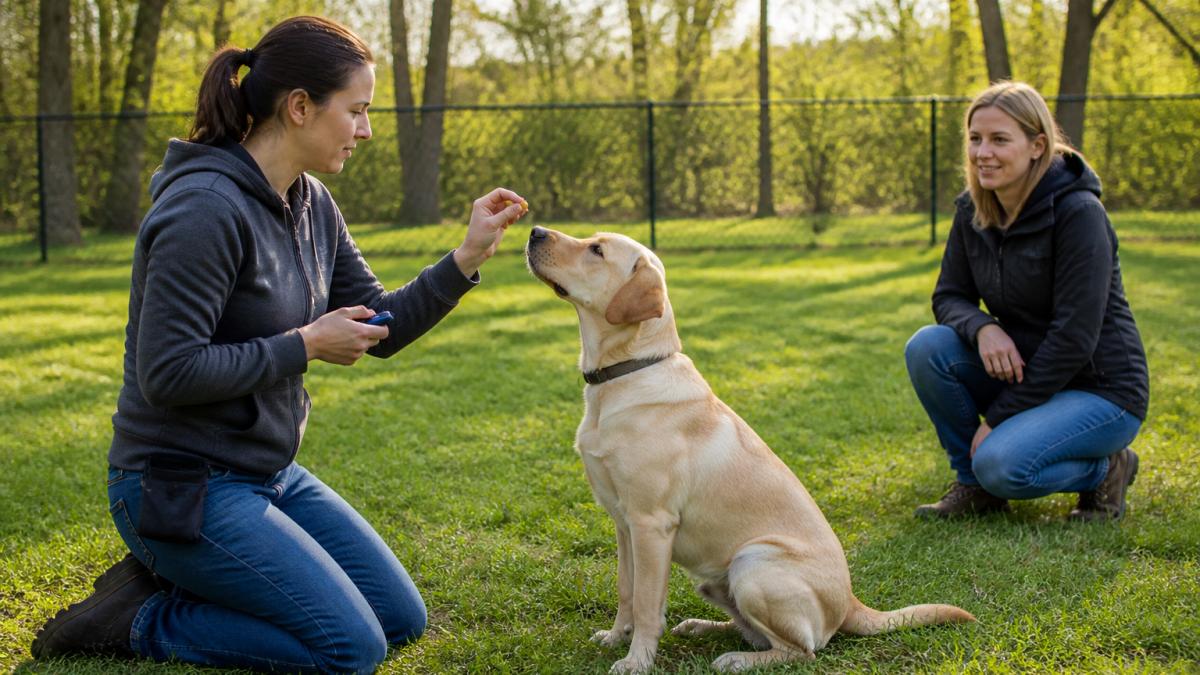
A marker, a click or a spoken word like "yes", tells the dog precisely which behavior earned the reward. Markers solve the timing problem: a click lands the instant the behavior happens, even if the treat arrives a second later.
Reward timing follows a simple rule: mark the behavior, then deliver the reward within a second or two. Food is the most practical reinforcer for most dogs, but toys and play work for dogs who value them more.
Dog Training Timing and Consistency: The Variables That Decide Results
Dog training timing and consistency decide whether a dog learns a behavior in days or never. Timing is the marker-and-reward sequence above; consistency is everyone in the household rewarding the same behaviors and ignoring the same ones.
New behaviors need continuous reinforcement, a reward every time. Once solid, intermittent reinforcement, rewarding some but not all repetitions, makes the behavior durable, the same principle that keeps slot machines profitable.
A Step-by-Step Plan for Common Behaviors
A practical training plan breaks a behavior into small steps, rewards each step, and adds difficulty only when the current step is reliable, behavior shaping, the backbone of science-based training. Every stage below has an observable pass criterion, so you know when to advance and when to hold.
The Three Behaviors That Matter Most
Recall, loose-leash walking, and settling keep dogs safe and households sane. Train in short sessions, five to ten minutes, two or three times a day, and end on a success. Three to five repetitions per step is usually enough; more in one sitting degrades quality.
Recall: From Name Recognition to Real-World Reliability
- Charge the marker and the cue. Say the dog's name or a cue like "come" once, then mark and reward immediately when the dog turns toward you. Ten repetitions in a low-distraction room. Pass criterion: the dog turns toward you on the first cue in 8 of 10 trials.
- Add distance indoors. Two people stand three feet apart and take turns calling. Reward only when the dog reaches the caller. Pass criterion: 8 of 10 successful recalls at three feet.
- Add mild distraction. Practice in a hallway with a toy visible but not in play. Pass criterion: 8 of 10 at five feet with a distraction present.
- Move outdoors on a long line. Use a 15- to 30-foot training line in a fenced or safe area. Never practice recall off-leash until it is reliable on a long line. Pass criterion: 8 of 10 at 15 feet with moderate distraction.
- Proof in new settings. Practice in the front yard, then a quiet park, then a busier park. Change one variable at a time. Pass criterion: 8 of 10 in each new setting before moving on.
Loose-Leash Walking: A Five-Stage Progression
- Stationary start. Reward the dog for standing calmly at your side before the leash moves. Pass criterion: 10 seconds of slack leash with the dog beside you.
- One step. Take one step; mark and reward if the leash stays loose. Pass criterion: 8 of 10 single steps with slack.
- Five steps. Walk five steps; reward loose leash, stop and wait when it tightens. Pass criterion: 8 of 10 five-step stretches with slack.
- Turns and pace changes. Add turns and speed changes; reward the dog for checking in with you. Pass criterion: 8 of 10 turns completed without tension.
- Real-world settings. Practice in a low-distraction outdoor setting, then a busier one. Pass criterion: 8 of 10 minutes of walking with a loose leash in the new setting.
If the leash tightens, stop moving; the walk resumes when it slackens. This is negative punishment, removing the forward motion the dog wants, one of the few aversive-adjacent procedures science-based trainers use, because it is mild and contingent on the dog's own behavior.
Settling: Teaching an Off-Switch
- Capture calm. Reward the dog for lying down on its own in a quiet room. Pass criterion: three captured downs in one session.
- Add a mat. Reward the dog for lying on a mat. Pass criterion: the dog goes to the mat and lies down within 10 seconds of being cued in 8 of 10 trials.
- Add duration. Reward longer and longer stays on the mat, starting at five seconds and building to two minutes. Pass criterion: two minutes of relaxed lying with no whining or repeated standing.
- Add distraction. Practice while you cook, watch TV, or have a quiet conversation. Pass criterion: two minutes of settled behavior with household activity present.
- Generalize. Bring the mat to a quiet cafe patio or a friend's living room. Pass criterion: two minutes of settled behavior in the new setting.
Measuring Progress and Troubleshooting Stalls
Track progress with a simple log: behavior, environment, success rate, and date. Define success as a percentage of trials, not a feeling. A stall usually means the step is too big, the environment too distracting, or the reinforcer not valuable enough. Shrink the step, reduce distractions, or raise reward value, in that order. If a dog regresses after a stressful event, drop back a stage and rebuild.
When to Stop and Reassess
If a behavior has stalled for two weeks of consistent practice, or the dog shows stress signals, lip licking, yawning, turning away, refusing high-value food, stop and reassess. Those signals mean the plan is moving too fast or the environment too hard, not that the dog is stubborn. For serious behavior issues, you can learn about our professional behavior modification service.
How to Choose a Dog Trainer Who Uses Evidence-Based Methods
The phrase "science-based" is not regulated, and any trainer can print it on a website. Instead of asking whether a trainer claims to be science-based, ask what they can show you and how they reason about uncertainty. That single shift separates credentialed, humane professionals from marketing.
What "Evidence-Based" Should Actually Mean
Evidence-based practice rests on three legs: the best available research, the professional's clinical experience, and the client's values and circumstances. A trainer who cites studies but ignores your dog's history is not practicing evidence-based training; neither is one who relies only on anecdote. Ask a prospective trainer to walk you through a recent case. A strong answer names the behavior principle at work, describes what they observed, and acknowledges what they were unsure about.
How to Read a Training Claim Like a Skeptic
Most dog-training claims online fall into a few recognizable patterns:
- Anecdote dressed as evidence. "This worked for my dog" is a data point, not a study. Case experience matters, but it should not outweigh consistent research findings.
- Appeals to nature or dominance. Claims that a method is "what wolves do" or "how dogs establish rank" usually misapply outdated research; modern behavioral science has largely moved past dominance-based models for pet dogs.
- Single-study certainty. One study rarely settles a question. Look for whether the finding has been replicated and whether the study used a control group, a reasonable sample size, and measurable outcomes.
Credentials: What to Ask and What They Actually Mean
Credentials vary widely; the letters after a name matter less than what they required. Ask:
- What did the certification require? Coursework hours, a proctored exam, mentored hands-on hours, and continuing education are meaningful. A weekend online certificate is not equivalent.
- Is the certifying body independent? A credential issued by the trainer's own business is a marketing tool, not a standard.
- Does the trainer commit to a humane standard? Many professional organizations publish position statements favoring reward-based methods and opposing aversive tools. Ask whether the trainer is bound by one.
Red Flags in a First Conversation
Watch for these signals when you interview a trainer:
- They cannot describe what happens when the dog gets it wrong without describing a correction.
- They dismiss your questions about welfare or stress signals.
- They promise a fixed timeline for a behavior problem before meeting the dog.
When to Seek a Qualified Professional Instead of DIY
Some problems are beyond a home training plan. Seek a credentialed professional promptly for:
- Bites that broke skin or repeated snapping, especially toward children.
- Sudden behavior changes in an adult dog, which can signal pain or medical illness, see a veterinarian first.
- Severe fear or panic that does not improve with a basic desensitization plan.
For these cases, ask whether the professional works with a veterinary behaviorist, a veterinarian with advanced training in behavior, for cases that may need medical evaluation alongside training. For a full walkthrough of vetting a professional, see how to hire a professional dog behaviorist, and once you've decided to hire, check our pricing before you commit.
Book a Free Evaluation with Lake County Dogs
Choosing the right approach is the hard part; applying it consistently is harder. At Lake County Dogs, we've spent over 25 years resolving aggression, fear, and anxiety with compassionate, science-based methods.
We build behavior modification plans around your dog's genetics, temperament, and learning history, and we work with both dogs and cats. If you're ready to see how these dog training methods apply to your dog, book a free evaluation and get a plan built for your household.
Frequently Asked Questions
What are science based dog training methods?
They are training methods built on learning theory, mainly operant and classical conditioning. Behavior that gets reinforced repeats; behavior that gets no reward fades. In practice this means marking the exact moment a dog does the right thing, rewarding it, and setting up the environment so the dog can succeed. Science based dog training methods avoid aversive tools and focus on clear cues, good timing, and consistency across everyone in the household.
Is reward-based dog training supported by scientific research?
Yes. Studies comparing training approaches generally find that reward-based dog training methods produce reliable obedience with fewer welfare risks than methods relying on physical punishment or fear. Dogs trained with positive reinforcement tend to show less stress behavior during sessions. The research also shows that aversive methods can suppress behavior without teaching the dog what to do instead, which is why reward-based training is the standard in professional behavior practice.
How often should I train my dog?
Short, frequent sessions beat long ones. Two to four sessions of five to ten minutes per day work well for puppies and most adult dogs, because attention and reward value drop in long sessions. Dog training timing and consistency matter more than total minutes: same cues, same rules, every day, with everyone in the household on the same page. Spread practice across different rooms and outdoor settings so the behavior generalizes.
Can science-based training help with fear or reactivity?
Yes, with the right structure. Fear and reactivity are usually addressed through desensitization and counter-conditioning: exposing the dog to a trigger at a distance it can handle while pairing that trigger with food or play. The key is keeping the dog under threshold, meaning it can still eat and think. This work moves slowly and is best guided by a professional, especially for aggression cases where safety and welfare risks are higher.
How can I tell whether a dog trainer uses evidence-based methods?
Ask directly what happens when a dog gets it wrong. Trainers who use positive reinforcement dog training explain that they manage the environment, lower difficulty, and reward the correct behavior instead of correcting the dog. Ask about tools: if the answer includes shock, prong, or choke collars as a first step, look elsewhere. Also ask about credentials and whether they assess your dog before recommending a plan. A free evaluation is a good sign the trainer wants data before quoting a program.
Are punishment-based dog training methods effective?
They can suppress a behavior in the moment, but the evidence points to real costs: increased fear, stress signals, and a higher risk of aggression in some dogs. Punishment also fails to teach an alternative behavior, so the dog often swaps one problem for another. For most family dogs, reward-based dog training methods reach the same obedience goals with fewer welfare risks and a stronger dog-human relationship.
Every dog can learn. The question is whether the training you're using gives that dog a fair chance. Start with a free evaluation, and we'll show you where to begin.